
Insulated vs non-insulated patio: is the upgrade worth it?
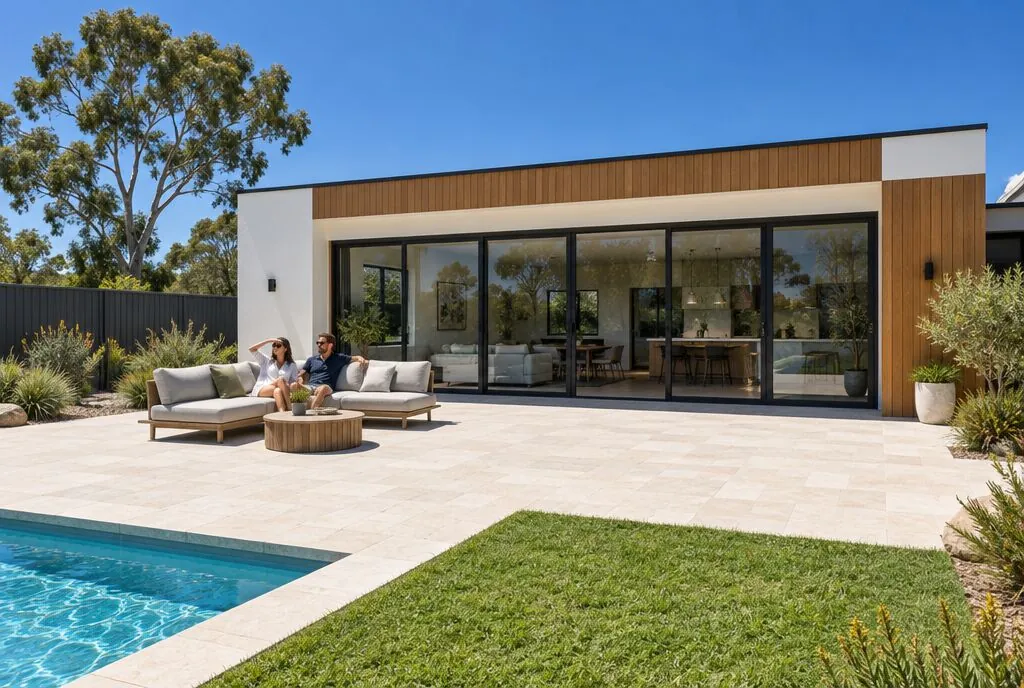
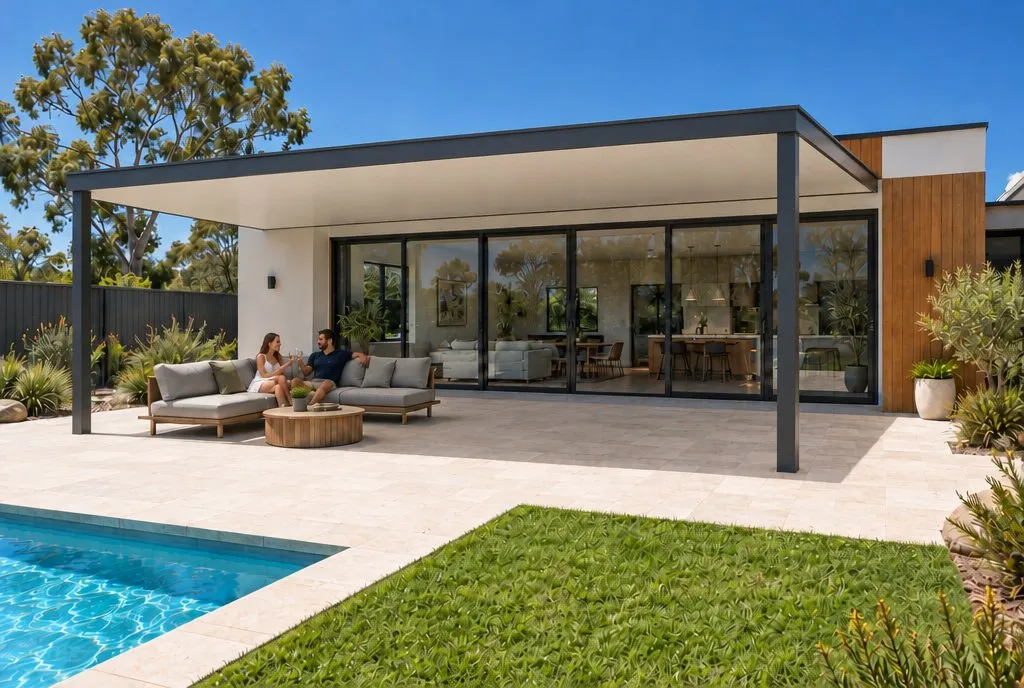 BeforeInsulated Roof Patio
In the insulated vs non insulated patio choice, an insulated patio uses roof panels with a foam core between two steel skins. It blocks far more of the sun's heat and gives you a finished ceiling. A non-insulated patio uses a single sheet of steel, which is cheaper but radiates heat down onto you on hot afternoons.
If you live somewhere hot, or the patio faces west or north, the insulated upgrade is usually worth it. Here is how the two compare in 2026.
Insulated vs non-insulated patio at a glance
| Non-insulated (single sheet) | Insulated panel | |
|---|---|---|
| Roof build | One Colorbond steel sheet on purlins | Steel top skin, foam core, steel underside |
| Heat under the roof | Underside gets hot in sun | Much cooler underside |
| Ceiling look | Visible sheet ribs and purlins | Smooth or VJ panel ceiling |
| Rain noise | Louder | Softer |
| Lights and fans | Exposed cables or extra lining | Cable ducts inside the panel |
| Spans | Needs more purlins | Long spans, fewer beams |
| Indicative price, 6 m × 4.5 m, Perth | $11,500 to $13,500 | $15,000 to $17,500 |
Prices are indicative installed ranges, rounded and including GST. An installer's site measure and quote set the real price.
Why patios get so hot
A thin steel roof heats up in direct sun. That heat then radiates down from the underside, so the space below can feel warmer than open shade under a tree.
Colour helps. BlueScope says most core Colorbond colours use its Thermatech solar reflectance technology. It lists 11 cool roofing colours with a solar absorptance of 0.45 or lower. Its highest reflectance option is Colorbond Coolmax in Whitehaven.
But a light colour on a single sheet only reduces the problem. It does not stop heat passing straight through the metal. That is the job insulation does.
How an insulated patio roof works
An insulated roof panel is a sandwich. Bondor's SolarSpan, one common brand, has a Colorbond steel top, a fire retardant expanded polystyrene core, and a pre-painted Colorbond steel underside.
The foam core slows heat moving through the roof. The steel underside becomes your ceiling, so there is no need for separate insulation, sarking or plasterboard.
Thickness and R-values
SolarSpan lists these R-values for its panels:
| Panel thickness | R-value |
|---|---|
| 50 mm | R1.20 |
| 75 mm | R1.80 |
| 100 mm | R2.40 |
| 150 mm | R3.60 |
Thicker panels insulate more and can span further between beams, but they cost more. Your installer picks the thickness to suit the span, your wind rating and your budget. For example, the brochure lists a 50 mm panel spanning up to 5.6 m in the lowest wind category, and longer for thicker panels.
Lights and fans
Insulated panels have ducts inside the foam for cabling. That makes it easy to fit downlights and ceiling fans with no wires on show.
One caution from the maker: only use downlights approved for the panel, because standard downlights may not meet the Australian Standards for insulated roofing. Ask your installer which ones they fit.
Warranty and finish
SolarSpan carries a 20 year manufacturer's warranty for patios and pergolas, with conditions. The underside comes in a plain smooth finish or a VJ finish with grooved lines, which suits older homes.
What about cost?
Insulation adds to the price, and the gap grows with size. Here are indicative installed prices for a 6 m × 4.5 m attached patio.
| Style | WA | VIC | QLD | NSW |
|---|---|---|---|---|
| Flat Roof Colorbond Patio | $11,500 to $13,500 | $12,500 to $14,500 | $12,500 to $15,000 | $13,500 to $16,000 |
| Insulated Roof Patio | $15,000 to $17,500 | $15,500 to $18,500 | $16,000 to $19,000 | $17,000 to $20,000 |
Remember to compare like with like. With a non-insulated roof, lights and fans often cost more to fit neatly, and some people later add a lined ceiling. For a deeper look, see the insulated patio cost guide and extras pricing.
Is an insulated patio worth it?
For most Australian homes in warm climates, yes. You pay once, and you feel the difference every summer afternoon.
When the upgrade usually pays off
- The patio faces west or north and gets afternoon sun
- You live in a hot city such as Perth, Adelaide, Brisbane or Darwin
- You want ceiling fans, downlights or a heater fitted neatly
- The patio is next to a living area and you want it to feel like an extra room
- You care about the look of the ceiling from inside the house
When a non-insulated roof can be fine
- The patio faces south, or sits in the shade of the house or trees
- It is mainly a carport style cover or a small walkway roof
- Budget is tight and you plan to use the space mostly in the evening
- You live in a cooler place such as Hobart and want some winter sun through clear sections
Ways to keep a patio cool without full insulation
If insulation is out of budget, you can still help:
- Choose a light roof colour. A cool colour reflects more of the sun, as BlueScope's data shows.
- Add a ceiling fan. Moving air makes a big difference, and Lysaght suggests fans for summer airflow.
- Go higher. A gable roof leaves more space for hot air to rise.
- Add side blinds. Low western sun comes in under the roof edge, not through it. The YourHome guide notes adjustable shading works best on east and west sides.
Insulation and light
An insulated roof is solid, so it shades the rooms behind it. Lysaght suggests skylights to bring in daylight, and insulated panel makers offer skylight options too.
SolarSpan notes that spans must be reduced when its Naturelite skylight is used, and that skylight is not for cyclonic regions. Your installer will plan this. Avoid large clear areas, because the YourHome guide notes that roof glazing takes in almost twice as much heat as an unshaded west facing window.
Which one should you choose?
- West facing yard in Perth or Adelaide, used every weekend: insulated, ideally with a fan.
- Shaded south side courtyard in Melbourne: a non-insulated flat roof is usually enough.
- Patio joined to an open plan living area: insulated with a VJ or smooth ceiling, so it feels like part of the house.
- Tight budget, small 3 m × 3 m cover: non-insulated in a light colour. A small insulated patio costs indicatively $11,500 to $13,500 in WA.
- Brisbane or Gold Coast, humid summers: insulated plus a fan, for heat and rain noise.
You can see an insulated patio on a photo of your own home in about 30 seconds with Backyard Mate, our free tool. It also shows an indicative price for your state.
Common questions
How much more does an insulated patio cost?
For a 6 m × 4.5 m patio in Perth, an Insulated Roof Patio is indicatively $15,000 to $17,500, against $11,500 to $13,500 for a Flat Roof Colorbond Patio. The gap is usually a few thousand dollars and grows with size.
How thick should insulated patio panels be?
Panels come in several thicknesses. SolarSpan, for example, lists R1.20 for 50 mm, R1.80 for 75 mm and R2.40 for 100 mm. Thicker panels insulate better and can span further, but cost more.
Are insulated patios quieter in the rain?
Insulated panel makers list noise deadening as a benefit, and the foam core does soften the sound of rain compared with a single steel sheet. They do not publish exact figures.
Can I add insulation to my existing patio?
Sometimes, by fitting a lined ceiling under the existing roof, but it adds weight and may need an engineer to check the frame. Often it is simpler to replace the roof sheets with insulated panels.
Do insulated patios make the house darker?
Yes, a solid roof blocks light like any other. Many people add skylights or a clear section near the house to keep rooms bright.
Keep reading
Sources
- SolarSpan Patio Brochure | Bondor (via Metroll)
- SolarSpan | Bondor (SteelSelect)
- Why choose COLORBOND steel? | BlueScope (SteelSelect)
- Shading | YourHome (Australian Government)
- Maximise your space: your blueprint for the perfect outdoor space | Lysaght
Prices on this page come from Backyard Mate's pricing for each state and are indicative only. Rules and products change: check with your council and installer before you build.