
Pergolas in Canberra: built for hot summers and frosty winters
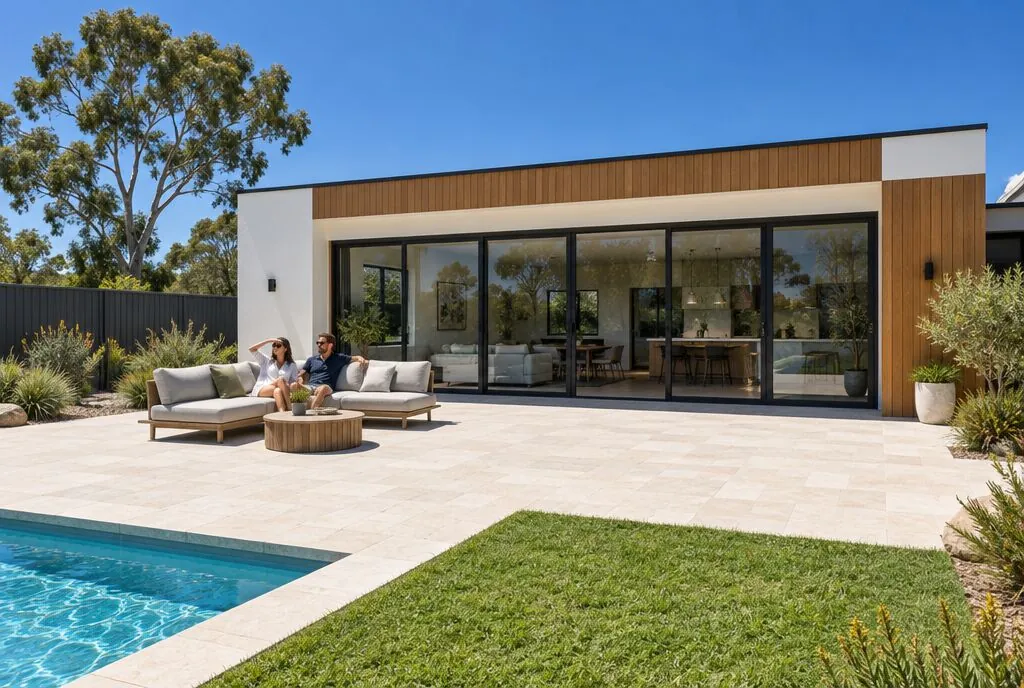
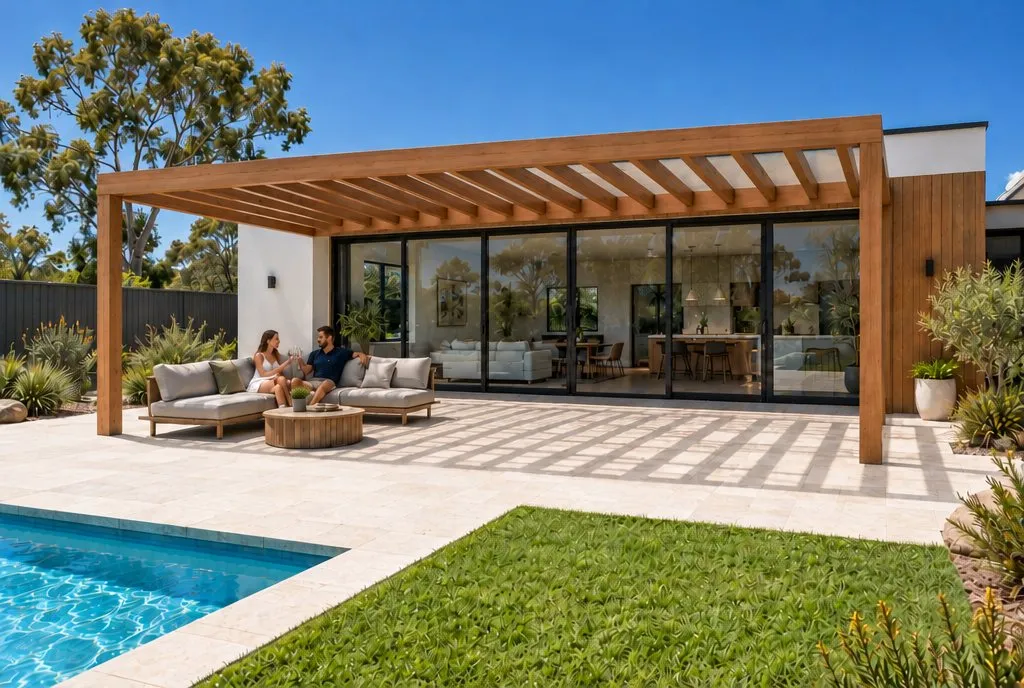 BeforeOpen Timber Pergola
Pergolas in Canberra cost from about $11,000 to $12,500 for a 6 × 4.5 m open timber pergola to about $32,000 to $37,500 for an adjustable louvre roof. Aluminium slat pergolas, pavilions and pergolas with a solid Colorbond roof sit in between.
In Canberra, "pergola" is used for open frames and for roofed structures off the back of the house. This page covers both, with a focus on open and opening roofs. For insulated and gable roofs, see our Canberra patios page.
What does a pergola cost in Canberra in 2026?
Here are indicative installed prices for the pergola styles in the ACT, including GST.
| Style | 3 × 3 m | 5 × 4 m | 6 × 4.5 m |
|---|---|---|---|
| Adjustable Louvre Pergola | $15,500 to $18,000 | $24,000 to $28,000 | $32,000 to $37,500 |
| Open Timber Pergola | $7,500 to $8,500 | $8,000 to $9,500 | $11,000 to $12,500 |
| Fixed Aluminium Slat Pergola | $11,500 to $13,500 | $11,500 to $13,500 | $15,000 to $18,000 |
| Pyramid Roof Pavilion | $15,000 to $17,500 | $17,000 to $20,000 | $23,000 to $27,000 |
Indicative installed prices in Australian Capital Territory, including GST, rounded. Pavilion is freestanding, the others attached to the house. Updated 28 October 2026.
If you want full rain cover, a pergola with a flat Colorbond roof is about $13,500 to $16,000 for the same size. ACT prices run higher than Perth or Adelaide. Approvals, engineering for longer spans, and lighting or heating all add to a Canberra quote.
Canberra's climate: two extremes in one year
Unlike the coastal capitals, Canberra gets both regular 35 °C days and regular hard frosts. The Bureau of Meteorology's Canberra Airport station shows:
| Canberra Airport (BOM) | January | July | Year |
|---|---|---|---|
| Mean max temperature | 30.0 °C | 12.9 °C | 21.1 °C |
| Mean min temperature | 14.2 °C | 0.1 °C | 6.8 °C |
| Days of 35 °C or more | 5.8 | 0 | 10.2 |
| Days at or below 0 °C | 0 | 15.8 | 58.8 |
| Mean daily solar exposure | 24.6 MJ/m² | 9.4 MJ/m² | 16.8 MJ/m² |
The coldest night on record there is minus 8.7 °C, and the hottest day is 44.0 °C. Canberra also averages only 69.5 rain days a year, so it is drier than Sydney or Melbourne.
For a pergola, that means two jobs. In summer, block hard afternoon sun. In winter, let in every bit of sun you can, because July delivers well under half the solar energy of January.
Which pergola styles suit Canberra?
Adjustable louvre pergola
A louvre roof is the neat answer to Canberra's extremes. Close or angle the blades on a 35 °C day. Open them fully on a frosty July morning to warm the paving and the house. It is the most expensive option, at about $32,000 to $37,500.
Open timber pergola
A timber pergola with a deciduous vine gives summer shade and bare winter branches. With nearly 60 frosty mornings a year, choose timber rated for the job. WoodSolutions rates H3 for outside, above-ground use and says in-ground structural posts need H5 or a Class 1 durable hardwood.
BeforeOpen Timber PergolaFixed aluminium slat pergola
Slats give reliable summer shade with no oiling. In winter they also block low sun, so keep them off north-facing living room windows.
Pergola with a Colorbond roof
A solid roof keeps frost and rain off the outdoor table and the barbecue. It also changes your approval path, as below.
Do you need approval for a pergola in Canberra?
The ACT has separate exemptions for building approval (BA) and development approval (DA). ACT Planning sets out both.
Approval in Australian Capital Territory, in short
In the ACT a carport, pergola or shade structure with no walls can skip both approvals if it is small: for building approval, roof area 25 m2 or less, 3 m high or less, floor no more than 1 m up and no span over 4 m. For development approval, an unenclosed roofed structure can be up to 50 m2 with no more than two side walls, must sit behind the building line and within height and solar envelope limits. Larger or enclosed structures need a building approval from a licensed building certifier and possibly a development application. Your builder or certifier usually handles this.
Read the Australian Capital Territory approval guide. Your installer usually handles the paperwork.
Building approval exemptions:
- Unroofed pergola: no walls and no more than 3 m above ground. The floor is no more than 1 m above ground, and no span (including a cantilever) exceeds 4 m unsupported.
- Roofed pergola or shade structure: the same limits, plus a roof plan area of no more than 25 m².
Development approval exemptions:
- Unroofed pergola: no roof or walls, and no more than 3 m above datum ground level. It can reach 4 m if no part is above a 30° plane.
- Roofed, unenclosed structure: roof plan area no more than 50 m² and no more than 2 walls. It must be behind the building line and inside any solar building envelope.
Two Canberra-specific catches follow. A 6 × 4.5 m roofed pergola is 27 m², just over the 25 m² BA limit. And a 6 m beam on two corner posts spans more than 4 m, so a middle post keeps it exempt. Our ACT council approval guide explains both approvals.
Things specific to Canberra
- Solar envelope: the roofed DA exemption requires the pergola to stay inside the solar building envelope, which protects your neighbour's winter sun.
- Front yards: a roofed pergola must be behind the building line to stay exempt from a DA.
- Bush edges: if your block backs onto a nature reserve or bushland, ask your installer whether bushfire construction rules apply before you choose timber.
How Backyard Mate works in Canberra
We are not a builder and do not install anything. The steps:
- Upload a photo of your backyard and pick louvre, timber, slat, pavilion or a roofed style.
- In about 30 seconds you see it on your own house, with an indicative ACT price.
- If you want a quote, one local installer who covers your suburb calls you. Only one.
Weighing up materials for frost and sun? Our timber vs aluminium pergola guide compares upkeep and cost.
Common questions
How much does a pergola cost in Canberra?
A 6 × 4.5 m open timber pergola in Canberra is about $11,000 to $12,500. Aluminium slats are about $15,000 to $18,000, and a louvre roof about $32,000 to $37,500. A pergola with a flat Colorbond roof is about $13,500 to $16,000. All are indicative installed ranges.
Do I need building approval for a pergola in the ACT?
Not for a small one. ACT Planning says an unroofed pergola needs no building approval if it has no walls and is no more than 3 m high. No part of the frame can span more than 4 m unsupported. A roofed pergola is also exempt if its roof is no more than 25 m².
Why does a 6 m pergola need a middle post in Canberra?
The ACT building approval exemption limits any unsupported span, including cantilevers, to 4 m. A 6 m beam on two corner posts exceeds that, so a middle post keeps the design inside the exemption.
Will a timber pergola survive Canberra frosts?
Yes, if the timber is right for the job. WoodSolutions rates H3 treated timber for outside, above-ground use, and says in-ground structural posts need H5 or a Class 1 durable hardwood.
Can a pergola go in front of my house in Canberra?
For the roofed, unenclosed structures exemption, ACT Planning says it must be behind the building line. A pergola in front of the house is likely to need a development application.
Keep reading
Sources
- Climate statistics for Australian locations: Canberra Airport | Bureau of Meteorology
- Check if you need a BA | ACT Planning
- Unroofed pergolas and arbours (building approval) | ACT Planning
- Unroofed pergolas and arbours (development approval) | ACT Planning
- Carports, pergolas and shade structures (development approval) | ACT Planning
- Preservative Treatments and Use Classes | WoodSolutions
Prices on this page come from Backyard Mate's pricing for each state and are indicative only. Rules and products change: check with your council and installer before you build.