
Verandahs and patios in Melbourne: see yours on your home and get a local price
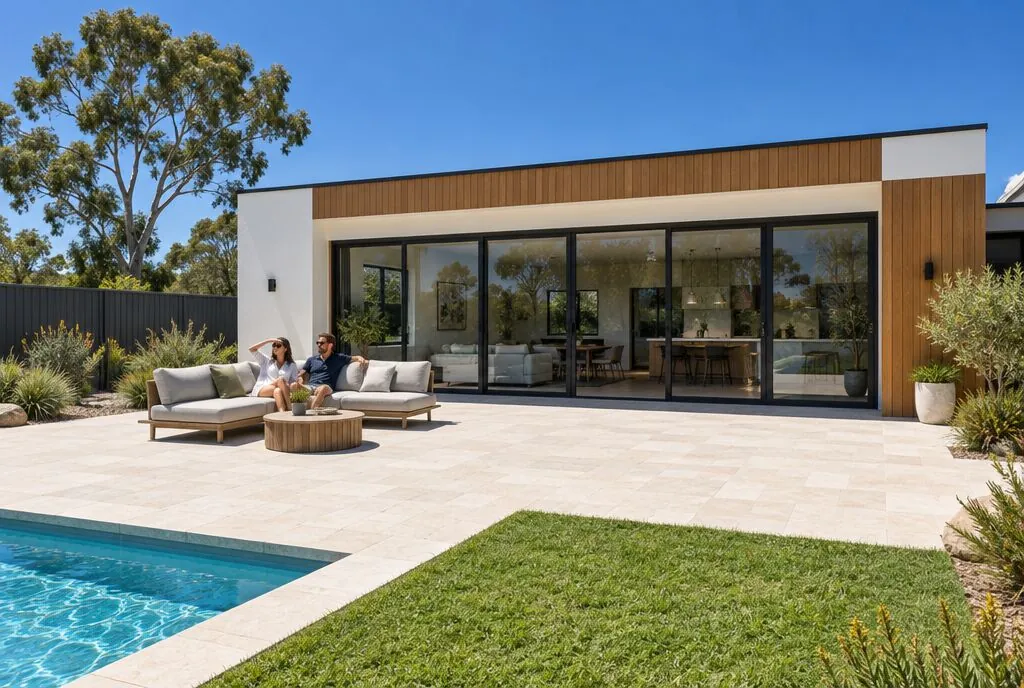
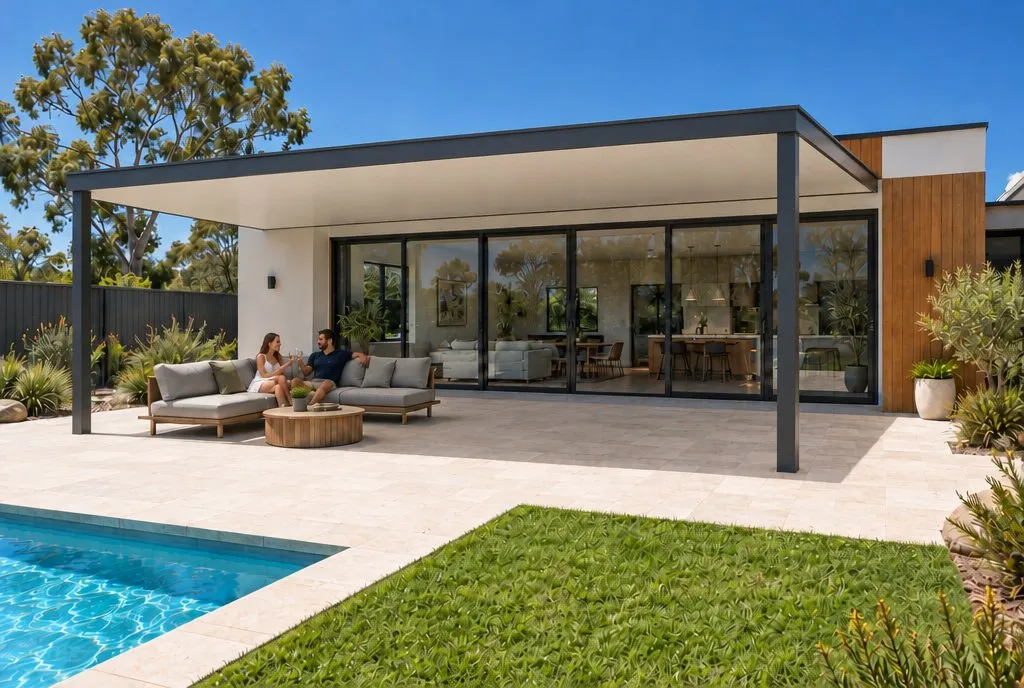 BeforeInsulated Roof Patio
In Melbourne, a roofed outdoor area attached to the house is usually called a verandah, and Victorian councils use the same word. In 2026 a 6 × 4.5 m flat Colorbond verandah costs about $12,500 to $14,500 installed, and an insulated one about $15,500 to $18,500.
Plenty of people say patio too, and it means the same thing. The City of Stonnington defines a verandah as an open-sided structure with a solid roof, and a pergola as one without. For open beams, slats or an opening louvre roof, see pergolas in Melbourne.
What does a verandah or patio cost in Melbourne in 2026?
The table shows our indicative installed prices for every style in Victoria, for a 6 × 4.5 m structure. They are rounded and include GST.
| Style | 3 × 3 m | 5 × 4 m | 6 × 4.5 m |
|---|---|---|---|
| Insulated Roof Patio | $12,000 to $14,000 | $12,000 to $14,000 | $15,500 to $18,500 |
| Flat Roof Colorbond Patio | $8,000 to $9,500 | $9,000 to $10,500 | $12,500 to $14,500 |
| Gable Roof Patio | $12,500 to $14,500 | $12,500 to $14,500 | $16,500 to $19,500 |
| Skillion Patio | $8,500 to $10,000 | $9,500 to $11,000 | $13,000 to $15,000 |
| Adjustable Louvre Pergola | $14,000 to $16,500 | $21,500 to $25,500 | $29,500 to $34,500 |
| Open Timber Pergola | $7,000 to $8,000 | $7,500 to $8,500 | $10,000 to $11,500 |
| Polycarbonate Roof Patio | $7,500 to $9,000 | $8,500 to $10,000 | $11,000 to $13,000 |
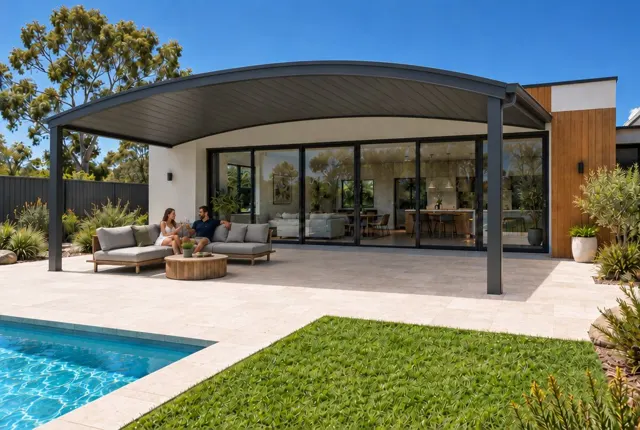
| Curved Roof Patio | $11,500 to $13,500 | $11,500 to $13,500 | $15,000 to $17,500 |
| Fixed Aluminium Slat Pergola | $10,500 to $12,500 | $10,500 to $12,500 | $14,000 to $16,000 |
| Pyramid Roof Pavilion | $14,000 to $16,000 | $15,500 to $18,000 | $21,000 to $24,500 |
Indicative installed prices in Victoria, including GST, rounded. Pavilion is freestanding, the others attached to the house. Updated 28 October 2026.
Victoria sits in the middle of the national price range. In Melbourne, permits add more to the bill than in most cities, because every verandah needs a building permit. Some also need a planning permit, which adds fees and time.
Your site matters too. Ground conditions vary across Melbourne, and some sites need deeper footings. A two-storey townhouse or a period home with a high fascia also needs taller posts.
Do you need a permit for a verandah in Melbourne?
Yes, always a building permit. Stonnington says "you always need a building permit to build a verandah or pergola". Monash says a building permit is required to build, renovate or demolish a verandah.
A planning permit is needed on top of that in some cases. Stonnington lists these triggers.
- Small lots: the land is under 300 m² and the verandah is 3 m high or more. The land must also be in a Neighbourhood Residential, General Residential or Residential Growth Zone.
- Heritage Overlay: a planning permit is required, including to demolish an existing structure.
If you need both permits, get the planning permit first. Monash also says you need the water authority's consent to build over a drainage easement.
Approval in Victoria, in short
In Victoria any verandah or roofed patio attached to a house needs a building permit, whatever its size. Only an open, unroofed pergola can skip the permit, and only if it is 20 m2 or less, 3.6 m high or less and not more than 2.5 m forward of the front wall. A planning permit is also needed if the land has an overlay such as a Heritage Overlay, or in some residential zones on small lots under 300 m2 when the structure is 3 m or higher. You choose a registered building surveyor, either private or from council, and most patio builders arrange this for you.
Read the Victoria approval guide. Your installer usually handles the paperwork.
Our guide to council approval in Victoria explains both permits step by step.
How does Melbourne's weather shape a verandah?
Melbourne's weather is famous for changing fast. The Bureau of Meteorology's long record at the Melbourne Regional Office shows why a verandah here works hard all year.
- Summer: average maximums of 25.9 °C in January and February, with about 10 days a year at 35 °C or more.
- Record heat: 46.4 °C on 7 February 2009.
- Rain: about 648 mm a year, but spread over about 100 rain days. October is the wettest month.
- Cloud: about 179 cloudy days a year, against about 49 clear days.
Then there are change days. The Bureau says a cool change can drop Melbourne's temperature by 15 °C or more within minutes. It can bring strong, squally winds, mostly from late spring to early autumn.
Which verandah styles suit Melbourne?
A Melbourne verandah needs to handle a 40 °C afternoon, a squally change and a grey, drizzly winter. Pick the roof for the whole year, not just January.
- Insulated roof: the all-rounder. It keeps the heat out in summer and makes the space feel less cold and damp in winter.
- Gable roof: a pitched roof often sits better against Victorian, Edwardian and Californian bungalow rooflines. It also gives more height.
- Polycarbonate roof: with so many cloudy days, keeping daylight in the living room matters. A clear or opal sheet lets light through.
- Skillion: raised at the outer edge, it lets the low winter sun reach the back windows.
Not sure whether insulation is worth it? Our guide to insulated vs non-insulated patios compares the two.
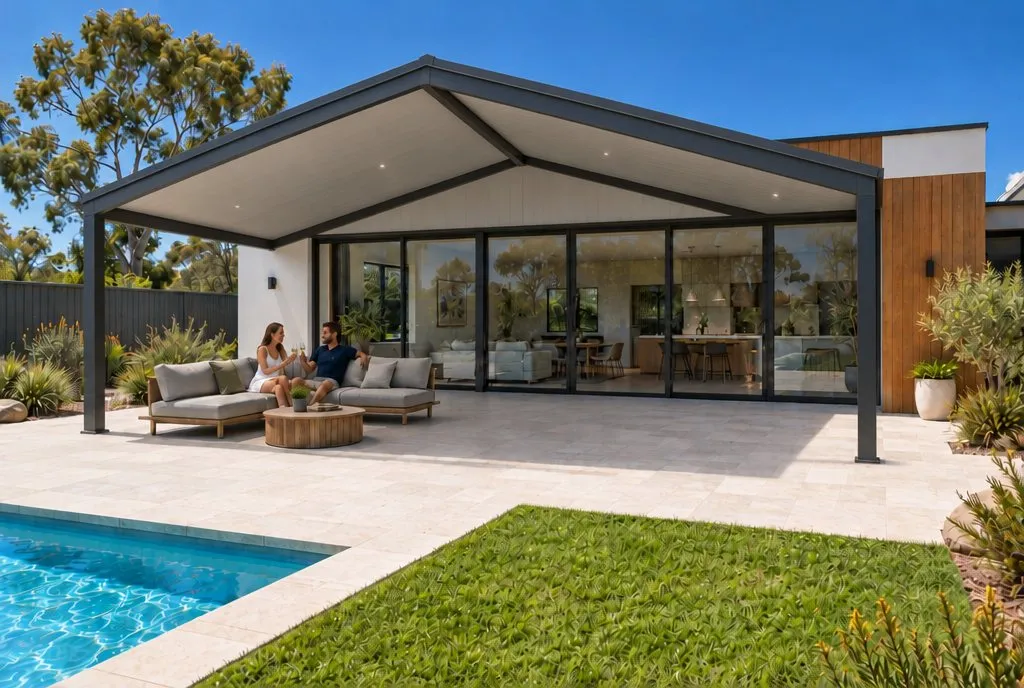 BeforeGable Roof Patio
What is different about building in Melbourne?
Period homes and heritage overlays
Many inner and middle suburbs are full of period homes, and some streets are under a Heritage Overlay. Monash says a verandah under a Heritage Overlay needs a planning permit if it is visible from outside the building. It also warns that permission for a modern verandah is unlikely. Rear verandahs that stay out of sight are usually the simpler path.
Townhouses and small lots
On a lot under 300 m², a verandah below 3 m high avoids Stonnington's small lot planning trigger. Ask your installer to design to that height if it suits your home.
Bushfire prone areas
Homes on the urban fringe and near bushland may be in a Bushfire Prone Area. The Victorian Building Authority says properties in a Bushfire Management Overlay need a planning permit as well as a building permit. Ask about BAL requirements before choosing materials.
How it works with Backyard Mate
We are not a builder and we do not install verandahs. We show you the design and an indicative price first.
- Upload a photo of your backyard and choose a style.
- See it on your own house in about 30 seconds, with an indicative Victorian price.
- Decide what happens next. If you want a quote, one local installer who services your suburb calls you, and only one.
Common questions
How much does a verandah cost in Melbourne?
A 6 × 4.5 m flat Colorbond verandah is about $12,500 to $14,500 installed in Victoria, and an insulated roof of the same size is about $15,500 to $18,500. These are indicative ranges including GST. A site measure and quote sets the real price.
Do I need a building permit for a verandah in Melbourne?
Yes. The City of Stonnington says you always need a building permit to build a verandah or pergola, and the City of Monash says the same for building, renovating or demolishing a verandah.
When does a Melbourne verandah need a planning permit too?
Stonnington requires one when the land is under 300 m², the structure is 3 m high or more and the land is in certain residential zones. A heritage overlay also triggers a planning permit. Get the planning permit before the building permit.
What is the difference between a verandah and a pergola in Victoria?
The City of Stonnington defines a verandah as an open-sided structure with a solid roof, and a pergola as an open-sided structure without one. So a Colorbond patio is a verandah in Victorian council terms.
Which verandah roof suits Melbourne weather?
An insulated roof suits Melbourne's mix of hot spells and cool, cloudy months. If the verandah will shade living room windows, a skillion or polycarbonate roof keeps more daylight in the house.
Keep reading
Sources
- Climate statistics for Australian locations: Melbourne Regional Office | Bureau of Meteorology
- Meet the locals: when the weather gives the place character | Bureau of Meteorology
- Verandahs and pergolas | City of Stonnington
- Verandahs | City of Monash
- Bushfire areas and overlays | Victorian Building Authority
Prices on this page come from Backyard Mate's pricing for each state and are indicative only. Rules and products change: check with your council and installer before you build.