
Attached vs freestanding patio: cost, approval and which to build
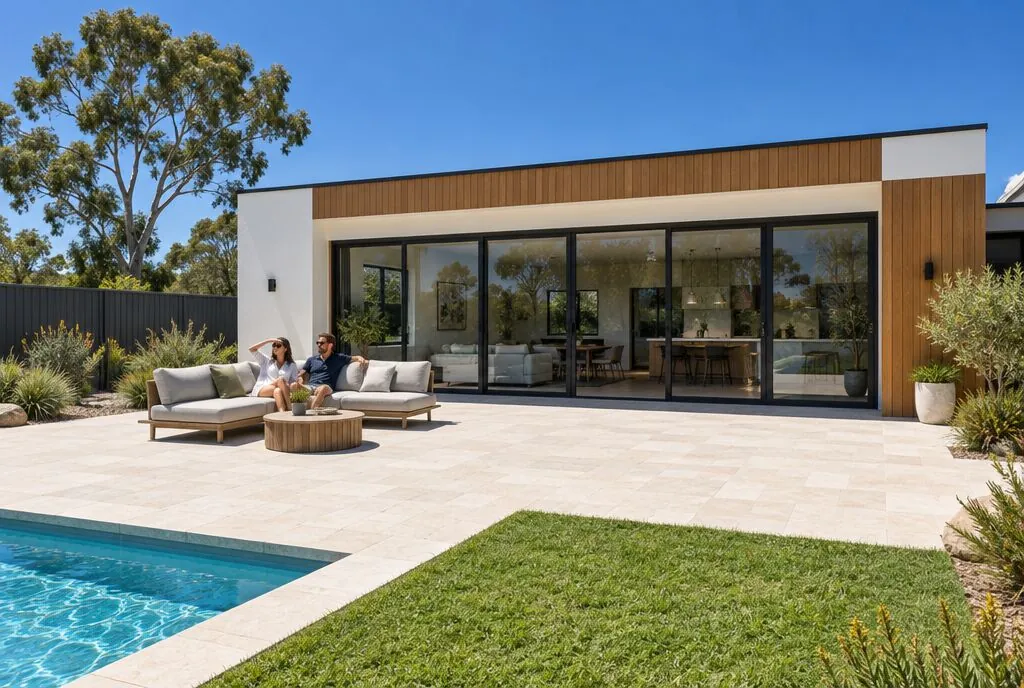
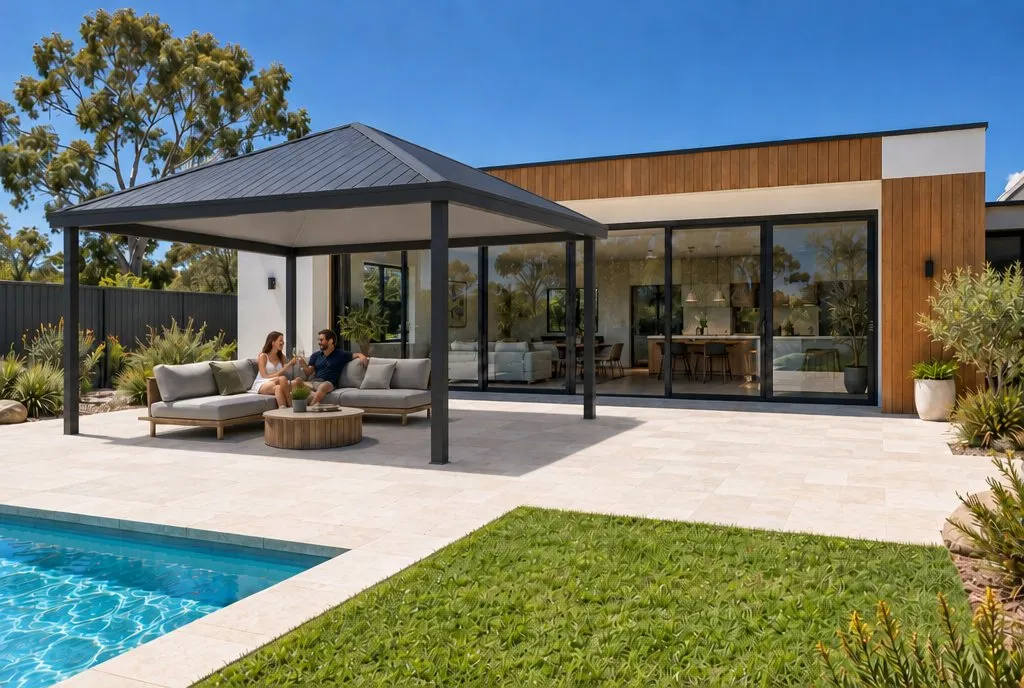 BeforePyramid Roof Pavilion
In the attached vs freestanding patio choice, an attached patio uses your house as one side of its support. It needs fewer posts and usually costs less. A freestanding patio or pergola stands on its own posts, so it can go anywhere in the yard. The extra posts, footings and beam usually add a few thousand dollars.
Patios in Australia are usually attached to the back of the house. Freestanding makes sense when the house wall or roof cannot take the load, or when you want shade out in the garden.
Attached vs freestanding at a glance
| Attached | Freestanding | |
|---|---|---|
| Support | House wall, fascia or a bracket on the roof, plus posts on the outer side | Posts on every side |
| Posts | Usually one row | Usually two or more rows |
| Cost | Lower | Usually adds a few thousand dollars |
| Position | Against the house | Anywhere: by the pool, in the garden, beside the house |
| Link to the house | Covered path from the back door | Needs a separate path or awning |
| Approval | Often needs a permit | Small ones are sometimes exempt |
| Good for | Outdoor living off the kitchen or living room | Pool shade, garden retreats, awkward roofs |
Prices for any size and style are indicative only. An installer's site measure and quote set the real price.
How an attached patio works
An attached patio fixes to the house on one side. Depending on the house, the installer may fix it:
- To the fascia, the board behind the gutter, if it is strong enough
- To the wall, with a beam bolted to brick or framing
- Above the roof, on brackets fixed through the house roof, so the patio sits higher than the gutter
The outer edge sits on a beam and a row of posts. With one row of posts and one beam fewer, it is the most economical way to cover the area right outside your back door.
Steel makers such as Lysaght note that most roof styles can be built either attached or freestanding. That includes flat, skillion, gable and Dutch gable.
When attaching is tricky
Attaching is not always simple. Common problems include:
- Old or soft fascias that cannot take the load
- Low eaves, which would leave the patio too low
- Upstairs windows on a double-storey home, which limit the height
- Tiled roofs that are fragile to work on
- Box gutters or complex rooflines
In these cases, a freestanding structure built close to the house is often the cleaner answer. See our guide to patios on double-storey houses.
How a freestanding patio works
A freestanding patio or pergola carries its whole weight on its own posts and footings. It does not touch the house, or it sits just beside it.
Because it stands alone, it has to resist wind on its own. That usually means more posts, deeper or larger footings, and a stiffer frame than the same attached patio.
Freestanding structures include:
- A freestanding flat, skillion or gable patio
- A freestanding pergola, timber or aluminium
- A pavilion or gazebo with a pyramid or hip roof, set out in the garden
BeforePyramid Roof PavilionFreestanding patio cost in 2026
A freestanding version of the same patio usually adds a few thousand dollars, for the extra posts, footings and beam. The exact amount depends on size, height, ground conditions and access.
Pavilions are a style of their own. A Pyramid Roof Pavilion is always freestanding and has a more detailed roof. Here are indicative installed prices for 6 m × 4.5 m, compared with an attached flat roof patio.
| Style | WA | VIC | QLD | NSW |
|---|---|---|---|---|
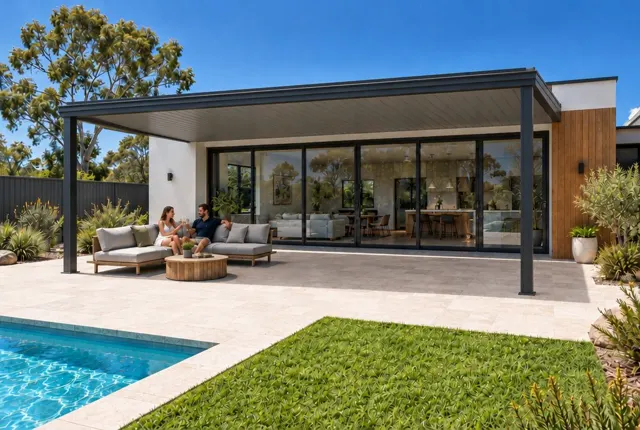
| Flat Roof Colorbond Patio (attached) | $11,500 to $13,500 | $12,500 to $14,500 | $12,500 to $15,000 | $13,500 to $16,000 |
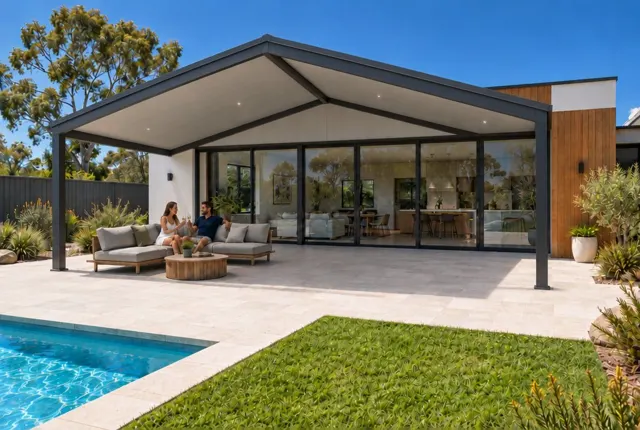
| Gable Roof Patio (attached) | $16,000 to $18,500 | $16,500 to $19,500 | $17,000 to $20,000 | $18,500 to $21,500 |
| Pyramid Roof Pavilion (freestanding) | $20,000 to $23,500 | $21,000 to $24,500 | $21,500 to $25,000 | $23,000 to $27,000 |
Freestanding also changes the extras. You may need a longer power run for lights or a fan, and a path to reach it. See the patio extras cost guide and the full patio cost guide.
Council approval: attached vs freestanding
Councils often treat the two differently. Attached structures are joined to your home, so they are usually assessed as part of it.
Two examples show the pattern:
- Shire of Toodyay, WA: attached patios, verandahs and carports always need a building permit. A freestanding one can be exempt only if it is 2.4 m high or less and 10 m² or less. It must also be outside wind regions C and D. Freestanding pergolas get up to 20 m².
- Townsville, QLD: building approval is generally needed if a covered area is not freestanding. It is also needed if the area is over 10 m², over 2.4 m high or has a side over 5 m.
Most full size patios go past those small limits anyway, so plan for approval either way. In NSW, exempt development allows up to 25 m² and 3 m high, behind the building line, with other conditions. Our council approval guide covers each state.
Even when a permit is not needed, the structure must still meet the building code and Australian Standards.
Light and shade
An attached patio shades the rooms behind it. That can be good on a hot west wall, and less good on a north facing living room in winter.
A freestanding structure set a few metres from the house lets light reach the windows. The YourHome guide notes that north is the easiest side to shade and the best for winter sun. So think about where your shade lands.
Which one should you choose?
- Back door opens onto a paved area: attached. It covers the path from the kitchen and costs less.
- Double-storey home with windows right above: freestanding next to the house, or attached below the windows if the height works.
- Old house with tired fascias or a tiled roof: freestanding beside the house, to avoid fixing to weak parts.
- Shade by the pool or at the bottom of the garden: freestanding patio, pergola or pavilion.
- You want to keep the living room bright: freestanding, set back from the house.
- Tightest budget: attached, in a simple flat roof.
You can see an attached patio or a freestanding pavilion on a photo of your own yard in about 30 seconds with Backyard Mate, our free tool. It also shows an indicative price for your state.
Common questions
Is a freestanding patio more expensive than an attached one?
Usually, yes. A freestanding patio needs an extra row of posts, footings and a beam where it would otherwise fix to the house, which usually adds a few thousand dollars to the same size and style.
Do freestanding patios need council approval?
Often, though some very small ones are exempt. In the Shire of Toodyay in WA, for example, a freestanding patio can be exempt only if it is 10 m² or less, 2.4 m high or less, and outside wind regions C and D.
Can a patio be attached to a double-storey house?
Yes. It usually fixes to the wall or a beam below the upstairs windows, or stands on its own posts next to the house. Your installer checks the wall, fascia and window heights on site.
How close to the house can a freestanding pergola be?
It can sit right beside the house, which is a common way to avoid fixing to weak fascias or tiled roofs. Boundary setbacks and fire rules still apply, so check with your council.
Keep reading
Sources
- Information sheet: patios, verandahs, carports, pergolas and shade sails | Shire of Toodyay
- Decks and covered areas | Townsville City Council
- Balconies, decks and patios: exempt development | NSW Planning Portal
- Patios, Pergolas & Verandahs | Lysaght
- Shading | YourHome (Australian Government)
Prices on this page come from Backyard Mate's pricing for each state and are indicative only. Rules and products change: check with your council and installer before you build.